Is Premier Smith’s New Drug Policy: Controversial or Compassionate?
Will Premier Smith follow through with her controversial Compassionate Intervention Act, which will force people with severe drug addiction into treatment?

Amidst a fierce election between Premier Danielle Smith and NDP leader Rachel Notley, Smith took home the win on Monday.
With the win under her belt, will Smith follow through with the Compassionate Intervention Act?
The act was announced on May 15 and would allegedly force people with severe drug addiction into treatment.
Specifically, the Compassionate Intervention Actwould give police and family members or legal guardians of drug users to refer adults and youths into involuntary treatment if they are a danger to themselves or others.
After the announcement, the act quickly drew criticism, with some alleging it would do more harm than good. This includes Dr. Cameron Wild, Professor of Public Health at the University of Alberta.
Wild believes that the UCP government has created a divide between treatment and recovery through policy, resulting in cuts to harm reduction services.
“A true system of care should keep drug users alive and promote their health until they’re ready to recover,” Wild told Press Progress.
In addition to Wild, Dr. Jennifer Jackson, an assistant professor in the faculty of nursing at the University of Calgary, believes the UCP government’s drug policies have made it harder to support people struggling with addiction.
“…services like supervised consumption sites, overdose prevention sites and other harm reduction measures—they’ve either been limited severely or outright eliminated,” said Jackson.
Supervised Consumption Sites (SCS) are places where people can use pre-obtained drugs in a monitored, hygienic, and safe space. SCS are intended to reduce harm, support prevention, and provide treatment for drug users.
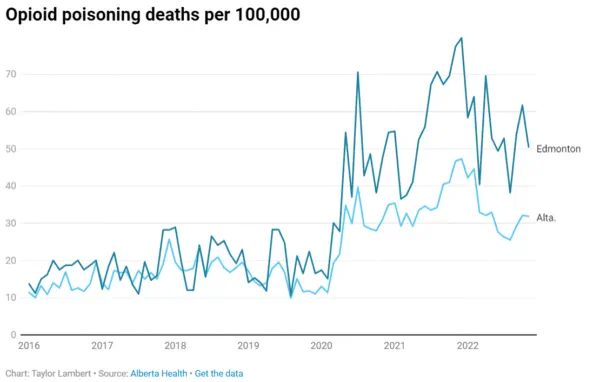
Taylor Lambert | CBC News
Since the UCP government was elected in 2019, there have been several government-led closures and transitions at SCS. Four years ago, there were 37 injection consumption boots in SCS across the province.
That number has dropped to 24 booths. The UCP also forced the Lethbridge ARCHES SCS to be closed in 2020, which had 13 booths and North America’s first drug inhalation area.
In April 2021, the government also permanently closed the Boyle Street Community Services’ SCS in Edmonton. Three people died in a downtown park shortly after due to drug overdoses.
But Smith’s UCP government claims to have added 10,000 treatment spaces to provide detox and recovery services to almost 30,000 people yearly.
“(This) will allow us to save the lives of addicts who are at risk of dying from an overdose and protect those who are at risk of being randomly attacked in our communities. This is actual compassion,” said Smith.
Smith’s government will allegedly create over 700 addiction treatment beds in 11 locations, including First Nations and five new 75-bed mental-wellness centres.
In an interview with Global News, UCP chief of staff Marshall Smith clarified that the Compassionate Intervention Actwould allow forced intervention but not forced treatment.
“It’s a completely voluntary process, and the individual can refuse the help that’s being offered,” said Smith.
Notley has applauded Smith’s investment into recovery but believes the Premier’s Compassion Intervention Act is flawed.