Coutts Left to Fend For Itself against “Domestic Terrorists”
The signs were there, so how was Alberta’s RCMP caught off guard?
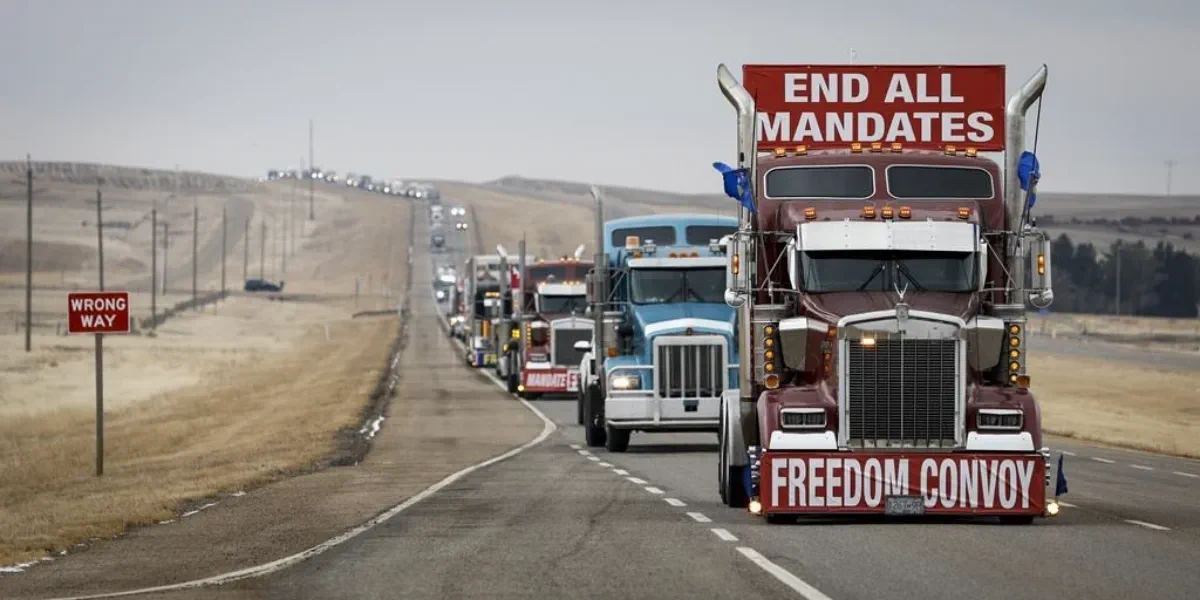
Earlier this year in January, Coutts, Alberta became a stomping ground for the “Freedom Convoy” protest.
On January 29, 2022, the massive convoy showed up at Coutts’ front door. It wasn’t long before trucks from the convoy began blocking roads in and out of the village.
For a village of just 245 people, the Freedom Convoy protest was devastating. Many of Coutts’ residents felt trapped in their own community.
“We had literally been locked in…I spent 15 years in the military, and I have never ever felt that feeling of no control over anything,” longtime Coutts resident Lori Minor told Global News.
Just to get out of town, residents had to cross through neighbours’ yards to get to Milk River where they could access essential services like grocery stores and doctors.
What is now known as the “Coutts Blockade” didn’t just cut off the village, it cut off the Coutts-Sweetgrass border crossing. This is Alberta’s busiest trade route.
The protest was eventually brought to a close on the same day the federal government used the Emergencies Act.
The Emergencies Act is a federal law that grants temporary additional powers to the federal government to respond to “national emergencies.”
The bottom line is, the “Coutts Blockade” wasn’t just a protest. For many of Coutts’ residents, it was a living hell.
But the Coutts Blockade could have been avoided. Earlier this month, Coutts Mayor Jim Willett testified that he warned the Alberta government well in advance of the protest.
According to Willett, he had seen social media posts and plans for the Coutts Blockade days before the convoy showed up at his doorstep.
Willett reached out to Alberta’s former premier, Jason Kenney, and was told not to worry about it and that the RCMP would handle it.
They didn’t. Well, they tried. The RCMP had the power to clear the convoy, but didn’t have the tow trucks to do it.
Alberta searched every nook and cranny in the province for tow trucks, but with no luck.
The province even looked for help from British Columbia, Saskatchewan, and the United States, but no one wanted to get involved.
Believe it or not, some tow truck companies were even paid to turn away the RCMP while others were threatened by convoy social media groups to stay out of it.
Unable to find tow trucks, Alberta turned to the federal government and asked for help. The government never formally responded, but an undrafted response says it all.
The letter response said that Alberta had all the legal authority it needed to end the protest. In other words, the federal government told Alberta to sort it out themselves.
With no other options in sight, the RCMP moved in on the convoy on February 14, 2022 and made several arrests.
At this point, the convoy had already begun to crumble. Convoy members began to leave on their own, along with their trucks.
Prime Minister Justin Trudeau seems to think the Emergencies Act was necessary to end the blockades in Ottawa and at border crossings like Coutts-Sweetgrass.
In reality, it was the RCMP that did the heavy lifting in Coutts, not the federal government.
Marlin Degrand, the assistant deputy minister in the Alberta solicitor general’s office, does not recall any of the provisions of the Emergencies Act being used to end the Coutts Blockade.
In other words, by the time a state of emergency was declared, Alberta had already busted its ass resolving the blockade.
So, was the use of the Emergencies Act really necessary? Well, Alberta certainly has its doubts, and rightfully so.
The Emergencies Act Inquiry that Mayor Jim Willett is testifying in is meant to look into whether or not the use of the Emergencies Act was actually needed.
The federal government left Alberta hanging during a crisis. Can Albertans expect the same in the future?