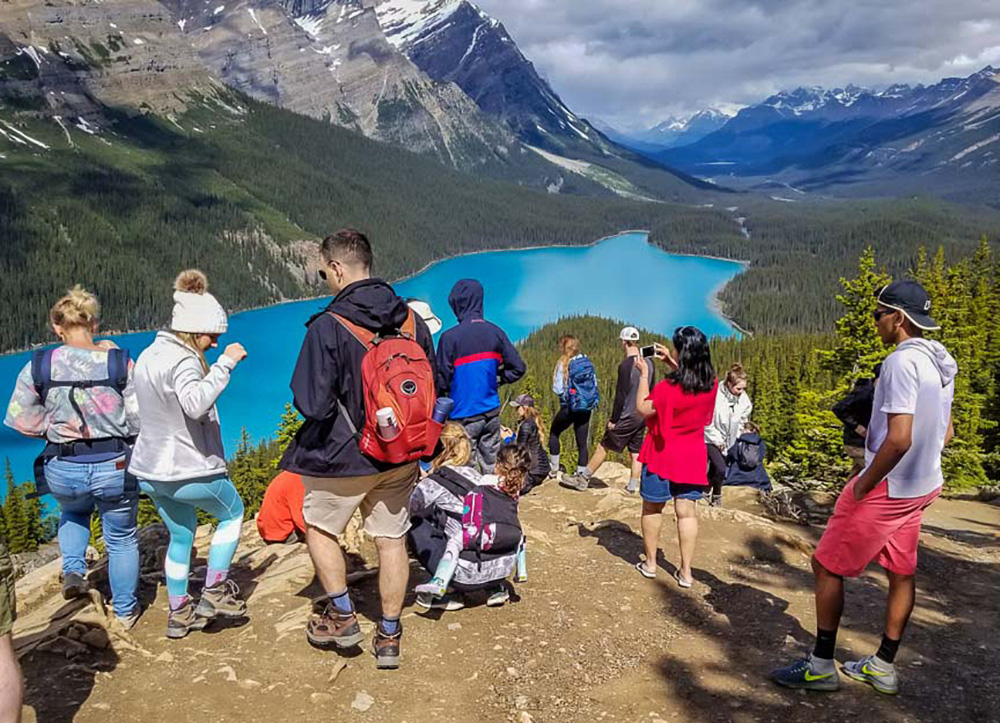
Over the past decade, Banff National Park has experienced an unprecedented surge in visitation.
The number of visitors has increased by 31% over the ten years, with record-breaking numbers reported in recent years.
However, this influx of people has sparked a debate about the park’s purpose.
Banff must cater to the millions who flock to enjoy its breathtaking scenery and abundant wildlife while upholding its mandate to restore and maintain ecological integrity. This dual responsibility is increasingly challenging to manage as rising tourism places the park at a crossroads.
The Friction of Banff’s Dual Mandate
The challenges posed by the park’s dual mandate are palpable for both conservationists and residents of Banff alike.

Peter Duck, a 40-year resident of Banff and president of Bow Valley Naturalists, has witnessed this friction first-hand. He recalls the quieter days of Banff, when summers, though busy, did not overwhelm the small town or its surrounding environment.
Today, Banff faces a tipping point, with tourism overwhelming the town and its ecosystems. Traffic congestion, noise pollution, and expanding infrastructure stretch the town to its limits.
“We love that [visitors] support our social structure,” Duck admits, “but we also have significant social and town planning issues to deal with.”
The growing demand for visitor access to the park means natural habitats are being compromised. According to Duck, wetlands have been replaced with parking lots, and wildlife struggle to move freely through the Bow Valley, as they once did.
The increase in human activity disrupts natural processes like forest fires through fire suppression. Wildfires are part of the park’s natural ecosystem, and decades of suppression have upset the natural balance, making forests more likely to burn on a colossal scale like we saw recently in Jasper National Park.
In Duck’s view, the unnatural changes in the fire cycle compromise the park’s ecological balance.

Tourism Tensions
Banff’s growing pains extend beyond ecological degradation.

The park’s infrastructure was not designed to accommodate such high visitation levels, leading to what Duck describes as a “space issue.”
The narrow corridors where wildlife and visitors must travel are increasingly congested, resulting in more wildlife-human conflicts and vast crowds of tourists at scenic attractions like Lake Louise, Peyto Lake, and Johnston Canyon. Duck’s analogy of a phone booth with glass walls pressing out as more visitors crowd the park perfectly encapsulates this challenge.
Local leaders, such as Banff Mayor Corrie DiManno, are acutely aware of the limitations. Over the 2024 Labour Day long weekend, Banff saw more than 32,500 vehicles enter the town in just one day, setting a new traffic record.
DiManno emphasizes the need for enhanced mass transit systems, such as buses or rail connections from nearby Calgary, as the current road network has remained unchanged since the 1990s. “These types of vehicle volumes are not sustainable in our small town,” DiManno notes.
Lake Louise and Moraine Lake, two of Banff’s most iconic spots, also feel the strain.
Private vehicles are now banned from Moraine Lake Road, and Parks Canada is considering similar restrictions for Lake Louise. Every day during the summer, an estimated 1,800 to 2,500 cars are turned away from the Lake Louise area, causing frustration among visitors and posing challenges for emergency services trying to navigate crowded roads.

Managing the Future
Parks Canada has implemented various strategies to mitigate these issues, including increasing shuttle services, campsite reservation systems, and paid parking.
However, more than these measures are needed to address the rising number of visitors. For example, despite shuttle programs, mass transit efforts in Banff moved only 1% of visitors last year.
Conservationists like Duck argue that the park needs to prioritize its ecosystems over economic growth. “If ‘more’ is the economic model, then the ecosystem is going to suffer,” he says.
Duck believes tourism and conservation can coexist, but only if given equal importance in decision-making. Others echo this sentiment and call for rethinking Banff’s tourism management approach.
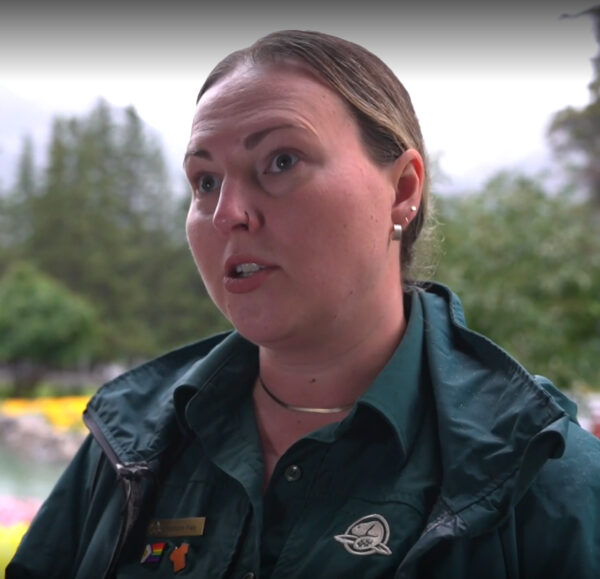
Natalie Fay, external relations manager for Banff National Park, shares that Parks Canada is in the early stages of developing management plans for highly visited areas like Lake Louise and Lake Minnewanka. These plans will consider various options, including traffic limits and timed entries, to balance visitor access with ecological preservation.
“We’re really open to everything,” Fay says, indicating that the park is exploring new ways to manage the growing number of visitors.

Toward a Balanced Solution
A potential solution lies in more comprehensive and forward-thinking planning.
Some, like Joel Hagen, a guide and resident of Lake Louise, believe the park must confront the uncomfortable reality that it cannot accommodate an endless number of visitors.
Hagen advocates for implementing quotas or caps on visitation to protect the environment and maintain the quality of life for residents. This idea contradicts the park’s emphasis on accessibility but may be necessary to preserve Banff’s unique ecosystems. A quota system has been successfully established in neighbouring Yoho National Park to regulate visitation in the ecologically sensitive Lake O’Hara area.
The increasing strain on the park’s search and rescue teams further underscores the need for careful planning. In 2023 alone, there were 56 search and rescue incidents in the Lake Louise area, ranging from sprained ankles to fatalities. As visitation continues to rise, ensuring the safety of both visitors and wildlife becomes more challenging.
Ultimately, Banff National Park’s future depends on finding a balance between welcoming visitors and protecting its delicate ecosystems.
As visitation grows, the park must innovate and adapt to maintain its dual mandate. The stakes are high: with significant changes, Banff can maintain both its natural beauty and the quality of the visitor experience that has made it so beloved.
Social media is already filling with posts about “never visiting Banff again.”